zoom_in
Procollagen Type III (PIIINP)
€1.00
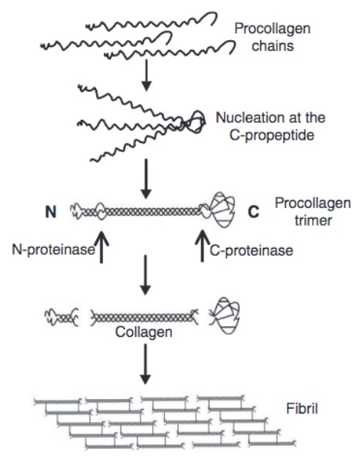
During synthesis of collagen, procollagen undergoes enzymatic cleavage at carboxyl and amino terminal ends by procollagen C-peptidase and procollagen N-peptidase and peptides are released into serum. Procollagen III Peptide is synthesized in fibroblasts as a precursor of collagen type III and then released.
In the healthy human liver, the most abundant collagens are the fibril-forming types I and III. Collagen types I and III are synthesized as procollagens with a small amino terminal and a larger carboxy-terminal propeptide. Once secreted into the extracellular space, the propeptides are removed by specific endopeptidases, thus allowing integration of the rigid collagen triple helix into the growing fibril. After this process the three-amino acid procollagen type III N-terminal peptide (PIIINP) is cleaved off procollagen type III forming collagen type III. It is released in serum, and for this reason their serum concentrations have been proposed as a useful marker of collagen type I and III synthesis. This is supported by a diversity of clinical observations demonstrating that high serum levels of these peptides reflect ongoing tissue fibrosis.
Currently, the serum measurement of procollagen type III N-terminal peptide by radioimmunoassay has been proposed as a useful test for monitoring disease activity and hepatic fibrosis in liver disease. Concentrations of procollagen type III N-terminal peptide in basal membrane are greater during hepatic fibrosis.
In the healthy human liver, the most abundant collagens are the fibril-forming types I and III. Collagen types I and III are synthesized as procollagens with a small amino terminal and a larger carboxy-terminal propeptide. Once secreted into the extracellular space, the propeptides are removed by specific endopeptidases, thus allowing integration of the rigid collagen triple helix into the growing fibril. After this process the three-amino acid procollagen type III N-terminal peptide (PIIINP) is cleaved off procollagen type III forming collagen type III. It is released in serum, and for this reason their serum concentrations have been proposed as a useful marker of collagen type I and III synthesis. This is supported by a diversity of clinical observations demonstrating that high serum levels of these peptides reflect ongoing tissue fibrosis.
Currently, the serum measurement of procollagen type III N-terminal peptide by radioimmunoassay has been proposed as a useful test for monitoring disease activity and hepatic fibrosis in liver disease. Concentrations of procollagen type III N-terminal peptide in basal membrane are greater during hepatic fibrosis.