

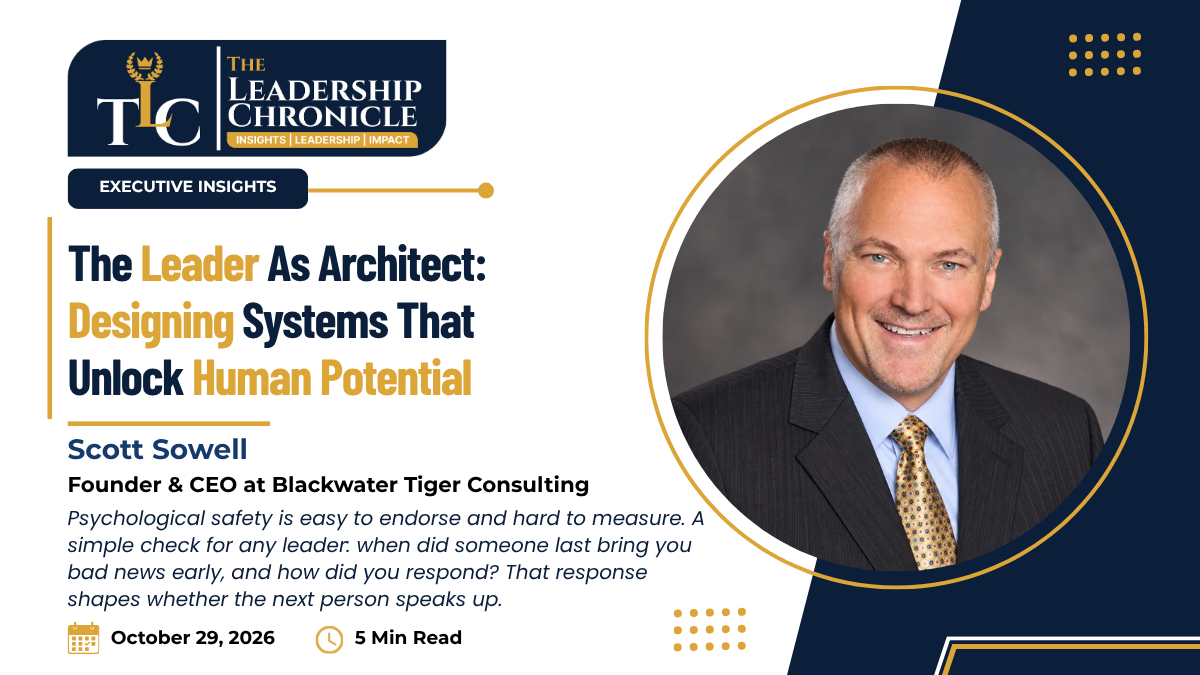
The Leader as Architect: Designing Systems That Unlock Human Potential

Most leaders are taught to think like operators. They are rewarded for solving problems, driving performance, meeting deadlines, and delivering results. These responsibilities matter, but they represent only part of the leadership equation. The greatest leaders understand that their most enduring contribution is not what they personally accomplish. It is the environment they create for others to thrive.
A leader’s true legacy is not measured by individual achievements but by the number of people who become capable of achieving more than they thought possible.
Effective leadership is less about command and control and more about intentional design. Leaders are architects. Their role is to design systems, relationships, and experiences that unlock human potential.
The Architecture of Human PotentialWhen most people hear the word “architecture,” they think of buildings. But architects do not lay every brick or install every window. Instead, they design structures that enable people to live, work, and flourish within them.
Leadership operates in much the same way.
Organizations often focus on strategy, processes, technology, and performance metrics. Yet many fail to recognize that human potential is also shaped by design. Every culture, communication practice, incentive system, and mentoring relationship creates conditions that either elevate people or constrain them.
People rarely fail because they lack talent. More often, they struggle because they are working within systems that fail to develop, support, or challenge them appropriately.
Architectural leaders recognize this reality. They understand that growth is not accidental. It is intentionally designed.
The question is not whether people possess potential. The question is whether leadership has created an environment where that potential can emerge.
“Try this as a one-week audit. Pick a single team and list three design choices, such as how feedback is given, who receives stretch assignments and how mistakes are handled, that help people grow, and three that quietly hold them back. The second list is usually where the work begins.”Moving Beyond Transactional LeadershipMany organizations remain trapped in transactional leadership models. Expectations are defined. Performance is measured. Rewards are distributed. Corrective action follows when standards are not met.
While these mechanisms serve important operational purposes, they rarely inspire transformation.
Transactional leadership asks:
“What did you accomplish?”
Architectural leadership asks:
“What are you becoming?”
This distinction changes everything.
Architectural leaders see employees not simply as resources but as developing human beings with unique strengths, aspirations, and untapped capabilities. They recognize that today’s entry-level employee may become tomorrow’s executive. Today’s struggling contributor may become tomorrow’s innovator.
Their responsibility extends beyond managing performance. It includes cultivating growth.
This is where mentorship becomes essential.
Mentorship as Leadership InfrastructureMany organizations treat mentoring as an optional activity. It often exists as a volunteer program, disconnected from strategic priorities.
The most successful organizations take a different approach.
They view mentoring as leadership infrastructure.
Infrastructure is not visible in every moment, yet it determines long-term performance. Roads, bridges, and communication networks enable movement and connection. In the same way, mentoring creates pathways for knowledge transfer, confidence development, succession planning, and leadership growth.
Mentorship accelerates what experience alone may take years to achieve.
It creates a structured process for helping others navigate challenges, avoid unnecessary detours, and gain perspective that only experienced leaders can provide.
Organizations facing leadership shortages, engagement challenges, and succession concerns cannot afford to treat mentoring as an afterthought.
If leadership development is a strategic priority, mentorship must become part of the organization’s architecture.
Designing for Psychological SafetyNo structure can support growth without trust.
One of the architectural leader’s most important responsibilities is designing environments where people feel safe enough to learn, contribute, and take risks.
Psychological safety has become a popular leadership topic, but its application remains inconsistent. Employees frequently hear that they are encouraged to speak up, challenge assumptions, and share ideas. Yet organizational behaviors often communicate something different.
People quickly discover whether vulnerability is rewarded or punished.
Architectural leaders understand that innovation and growth require emotional safety. They intentionally create spaces where questions are welcomed, mistakes become learning opportunities, and diverse perspectives are valued.
When trust exists, employees engage more deeply. Creativity increases. Collaboration improves. Learning accelerates.
Without trust, potential remains hidden.
Safety is not a soft leadership concept. It is a strategic requirement for human development.
“Psychological safety is easy to endorse and hard to measure. A simple check for any leader: when did someone last bring you bad news early, and how did you respond? That response shapes whether the next person speaks up.”Building Pathways Instead of BarriersMany organizations accidentally create barriers to growth.
Information is hoarded. Opportunities are reserved for a select few. Feedback arrives only during annual performance reviews. Leadership development is offered only to individuals already identified as high performers.
The result is predictable. Talented people stagnate.
Architectural leaders take the opposite approach.
They design pathways.
They create opportunities for visibility, learning, coaching, stretch assignments, and cross-functional experiences. They connect people with mentors. They encourage skill development. They expose emerging leaders to challenges that expand their capabilities.
Most importantly, they believe development should be intentional rather than exclusive.
When people can see a pathway forward, they invest more fully in their own growth.
Potential thrives where possibility is visible.
The Power of LightLight reveals.
It clarifies.
It guides.
It illuminates possibilities that may otherwise remain hidden.
Exceptional leaders do for people what light does for a path.
They help individuals recognize strengths they may not fully see in themselves. They provide perspective during uncertainty. They illuminate growth opportunities. They offer encouragement when confidence falters.
Importantly, light is not about control.
A lighthouse does not steer ships. It helps them navigate.
Similarly, great leaders do not create dependency. They create capability.
Their goal is not to become indispensable. Their goal is to develop people who can succeed without them.
“The lighthouse image offers a practical test. If you were unavailable for a month, which decisions would your team still make well? Where the answer is “none,” the next investment is capability, not control.”This is leadership in its highest form.
Creating a Legacy That EnduresLeadership is often measured through quarterly results, financial outcomes, or organizational performance. While these indicators matter, they capture only part of the picture.
At some point, every leader leaves.
The more important question is what remains.
Did people grow?
Did future leaders emerge?
Did others discover capabilities they never knew they possessed?
Did the culture become stronger?
Did the organization become better equipped to thrive?
Architectural leaders understand that legacy is built person by person, relationship by relationship, and conversation by conversation.
The systems they create continue producing value long after they are gone.
Their influence extends beyond organizational charts and reporting structures.
It lives within the people they developed.
Final ThoughtsThe future belongs to leaders who recognize that their primary responsibility is not simply managing work. It is designing environments where human potential can flourish.
In a world increasingly shaped by technology, automation, and rapid change, human development remains the ultimate competitive advantage.
Organizations do not achieve extraordinary outcomes because they have extraordinary strategies alone. They achieve them because they cultivate extraordinary people.
The leader as architect understands this truth.
They build trust. They create pathways. They mentor intentionally. They illuminate possibilities.
And in doing so, they design something far more important than a successful organization.
They design a future where others can become the fullest expression of their potential.
For more details, visit: https://theleadershipchronicle.com/ ↗
If you would like to get featured or want to know more, connect with us at [email protected] ↗
LinkedInn : https://www.linkedin.com/company/the-leadership-chronicle/ ↗
Twitter : @TLChronicle ↗