

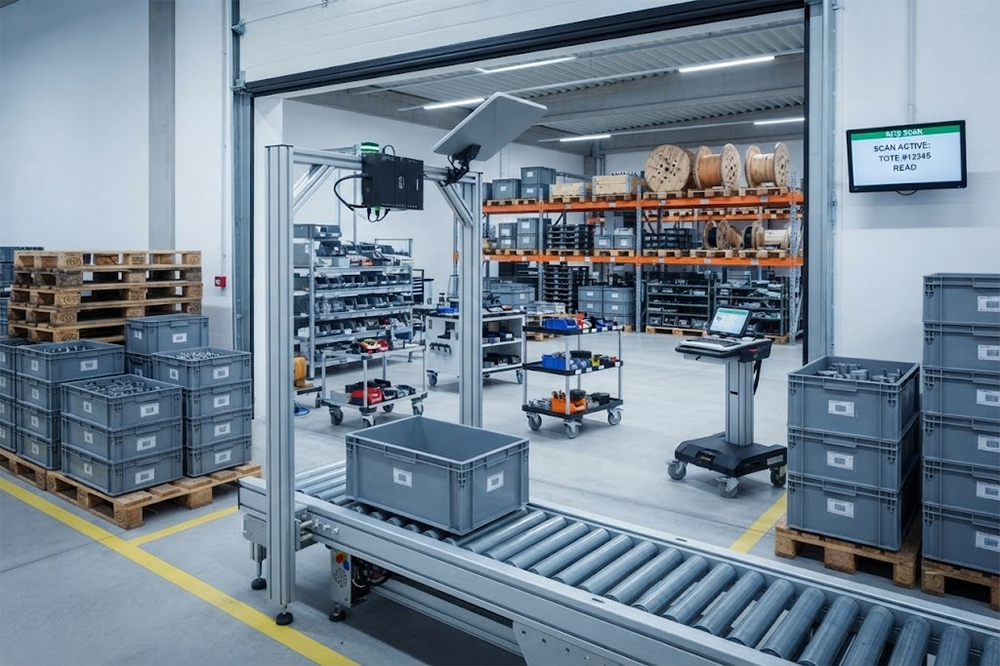
Long Range RFID Scanner for Smart Factories: How to Track Equipment and Materials Automatically
A long range RFID scanner supports smart factory automation by identifying tagged materials, equipment, work-in-process products, and reusable containers as they move through production lines, warehouses, and logistics checkpoints.
The reader detects RFID Tags ↗, while software connects each detection event to a production order, inventory record, equipment status, or material movement. A reliable system depends on tag selection, antenna placement, reading-zone control, and integration with factory software.
How Does RFID Work in a Smart Factory?A typical smart factory RFID workflow looks like this:
RFID tag → antenna → long range RFID scanner → EPC data → PLC or software platform → production event
For example, a tagged material container leaves the warehouse. A reader at the warehouse exit detects the tag and sends the EPC to the factory management system.
The software may then update the container status to:
Released from inventorySent to productionAssigned to a work orderReceived at a workstationWaiting for inspectionReturned to storageThe RFID reader identifies the physical object. The factory software determines what that identification means.
This connection between physical movement and digital records is one of the most useful parts of RFID in smart manufacturing.
Tracking Raw Materials and Production SuppliesFactories often move raw materials between storage areas, preparation rooms, production lines, and inspection stations.
Depending on the industry, RFID can be used to track:
Raw material containersComponent binsCable reelsPlastic cratesMetal traysPalletsWork-in-process containersPackaging materialsSpare partsReusable transport boxesA long range RFID scanner can identify several tagged containers as they pass through a warehouse gate or production checkpoint.
This can reduce the need for workers to stop and scan each barcode manually. It can also provide better visibility into whether the correct material reached the correct production area.
However, RFID does not automatically understand the material itself. The EPC must be connected to a database record containing the part number, batch, quantity, supplier, or production order.
RFID for Work-in-Process TrackingWork-in-process, or WIP, tracking is a common smart factory application.
A product may pass through several stages:
Material preparation → assembly → testing → inspection → packaging → finished goods warehouse
An RFID tag can identify the product, tray, pallet, or reusable carrier at each stage.
The system can record:
Which item arrived at a workstationWhen the item entered productionWhich process was completedWhether the item passed inspectionWhich station handled the itemWhether the item is waiting or delayedWhen the item moved to the next stageIn some factories, attaching a tag directly to every product may not be practical. A reusable carrier, tray, pallet, or workpiece fixture may be a better RFID target.
The correct choice depends on product size, material, production cycle, reuse frequency, and required traceability.
Long Range Does Not Mean Unlimited ReadingSmart factories contain many nearby objects, machines, shelves, and production stations. A reader that detects tags too far away may create incorrect production events.
For example, a reader installed at Station A might also detect a tagged tray waiting at Station B. The software could then incorrectly record that the tray has already entered the next process.
A controlled reading zone is therefore more important than the largest possible reading distance.
Reading-zone control may involve:
Directional antennasAntenna height and angleReader output powerPhysical spacingShielding or barriersSensor triggersPLC signalsSoftware time windowsEPC filteringDirection detectionSeparate antennas for entry and exitThe goal is to detect the intended item at the intended point—not every tag in the surrounding factory.
Antenna Position and Production LayoutAntenna installation should follow the actual movement path of the product or carrier.
Common installation options include:
Side-Mounted AntennaA side antenna may work well when products pass through a narrow conveyor or doorway. It can provide a more controlled reading area than an antenna pointed across a large room.
Top-Mounted AntennaA top-mounted antenna may suit products moving beneath a conveyor or through a defined transfer point. Tag orientation must be tested because some tags may face away from the antenna.
Multiple AntennasMultiple antennas can improve reading reliability when products have different orientations or when one antenna cannot cover the complete reading area.
However, adding more antennas can also increase unwanted reads. The antenna layout should be designed around the product path and the required detection zone.
RFID TunnelAn RFID tunnel can create a more controlled environment for cartons, trays, or containers. It may be useful when the product shape and movement direction are relatively consistent.
RFID and PLC IntegrationSmart factories often rely on PLCs, sensors, conveyors, robots, and manufacturing execution systems.
The RFID reader may communicate with the factory control system through:
EthernetTCP/IPSerial communicationDigital inputs and outputsAPISDKHTTPMQTTIndustrial gatewayMiddleware platformA sensor can tell the system that a pallet or container has arrived. The RFID reader can then identify the tag. The PLC or software can combine both signals to create a more reliable event.
For example:
A photoelectric sensor detects a container.The PLC triggers the RFID reading window.The reader identifies the EPC.The software checks the expected material list.The system confirms or rejects the material.The conveyor or production process continues.This approach can reduce false reads and improve synchronization between RFID and factory automation equipment.
Tracking Tools, Fixtures, and Production EquipmentSmart factories do not only need to track materials. They also manage tools and equipment that move between production lines, maintenance rooms, and storage areas.
Possible RFID assets include:
Assembly toolsInspection instrumentsProduction fixturesMoldsJigsDiesTool cartsMaintenance casesCalibration equipmentReusable equipment containersPortable testing devicesA fixed reader at a tool room entrance can record when equipment leaves or returns. Another reader near a production area can record when a tool arrives at a workstation.
For valuable tools and fixtures, RFID can also support maintenance scheduling, calibration records, and usage history.
The RFID tag provides the identity. The asset management system stores the maintenance and operational information.
RFID for Reusable Containers and PalletsMany factories use the same containers repeatedly between suppliers, warehouses, production lines, and finished goods areas.
Without reliable tracking, reusable containers may be:
Left at the wrong workstationSent to another factoryHeld in a shipping areaMissing from the return cycleCounted incorrectlyUsed for the wrong materialRFID can provide automatic detection at key points.
For example, a tagged container may be recorded when it:
Arrives from a supplierEnters the raw material warehouseMoves to productionReturns emptyEnters the cleaning areaLeaves for another facilityFor metal containers or pallets, the tag should be selected and mounted for metal surfaces. The tag position should also avoid areas where it may be damaged during handling.
Can RFID Read Multiple Factory Assets?UHF RFID readers ↗ can identify multiple tags in a reading zone. This is useful for carts, pallets, containers, and groups of work-in-process products.
Actual performance depends on:
Tag quantityTag spacingProduct materialMetal structuresLiquid contentTag orientationReader output powerAntenna configurationConveyor speedReading-zone sizeSoftware filteringA pallet carrying several tagged cartons may produce a different result from a single carton moving through the same reader.
Testing should therefore include the real packaging, real carrier, actual tag placement, and normal production speed.
A Practical Smart Factory RFID ExampleConsider a factory that produces electrical components. Raw materials arrive in reusable containers and move through several assembly and testing stations.
The factory installs long range RFID scanners at:
The raw material warehouse entranceThe material preparation areaThe assembly line transfer pointThe inspection stationThe finished goods warehouseEach reusable container receives an RFID tag. The ERP or MES system stores the EPC together with the material number, batch, and current process status.
During the pilot project, the reader at the assembly line detects containers waiting at a nearby station. The integrator adjusts the antenna angle, reduces unnecessary power, and uses a PLC sensor to trigger the reading window.
The final system records the intended container only when it enters the transfer point. The software then checks whether the material matches the production order.
This type of result comes from coordinating RFID hardware, factory layout, control signals, and software logic.
What Should You Test Before Deployment?A smart factory RFID project should be tested under actual production conditions.
Important test items include:
Product and container materialsMetal and liquid contentRFID tag typeTag mounting positionTag orientationReading distanceAntenna directionReader output powerNumber of tagsConveyor speedProduct spacingNearby production equipmentSensor trigger timingPLC communicationDuplicate read filteringExpected versus unexpected tagsSoftware event logicERP or MES integrationRepeatability over multiple production cyclesTesting only one tag on a table is not enough. The real test should include the complete container, product, conveyor, antenna, sensor, and software workflow.
What Should Distributors and System Integrators Look For?For smart factory projects, buyers should evaluate both RF performance and automation compatibility.
Important procurement points include:
Supported UHF frequency rangeEPC C1G2 / ISO18000-6C compatibilityReader sensitivityAdjustable output powerNumber of antenna portsAntenna compatibilityMulti-tag reading capabilityCommunication interfacesAPI and SDK supportDigital input and outputPLC integration optionsTrigger supportFirmware stabilityIndustrial installation optionsOn-metal RFID tag compatibilityOEM and private-label supportSample availabilityMOQLead timeTechnical supportBulk supply capabilityA reader may have strong RF specifications but still be unsuitable if it cannot communicate with the factory’s PLC, MES, ERP, or middleware platform.
Long Range RFID Scanner or Barcode?RFID and barcode systems can work together.
Barcode scanning may remain useful when:
The item has no RFID tagA worker needs to confirm a single productThe barcode is already printed on the packagingThe reading zone is not controlledThe project budget is limitedRFID may be more useful when:
Several items must be identified togetherWorkers need hands-free identificationProducts move through fixed checkpointsThe factory needs automatic event recordsTags may be hidden or difficult to scan individuallyReusable containers require movement trackingMany smart factories use a hybrid approach rather than replacing every barcode process.
Final TakeawayA long range RFID scanner can help smart factories connect physical material movement with digital production data. It can track raw materials, work-in-process products, tools, fixtures, pallets, equipment, and reusable containers at warehouses and production checkpoints.
The most reliable system combines:
Suitable RFID tagsCorrect antenna placementControlled reading zonesReader and PLC integrationSoftware filteringERP or MES connectivityReal-world production testingThe goal is not simply to read tags from a long distance. The goal is to identify the correct asset, at the correct process point, and record the correct manufacturing event.