

How to Track Footwear Size Availability and Assortment Gaps with Web Scraping
How to Track Footwear Size Availability and Assortment Gaps with Web Scraping
A shoe can appear in stock online even when its most important sizes are unavailable. For footwear brands and retailers, this makes product-level availability a poor measure of what customers can actually buy. Researching the footwear market with web scraping allows teams to compare individual size and color variants rather than relying on a single stock label.
With ecommerce data scraping services ↗, merchandising teams can build comparable datasets across retailers and monitor changes in assortment over time. The following framework shows how to turn those observations into useful category intelligence.
Why size-level availability mattersA retailer may offer a running shoe in seven sizes but have only three available for purchase. Another may stock every listed size while offering a narrower range. These are different problems: temporary stockouts reduce availability, while unlisted sizes may indicate an assortment gap. Colorways and widths introduce additional variation that a product-level stock flag cannot capture.
Research on size substitution and assortment planning ↗ explores the relationship between size choices and inventory decisions. For competitive research, this reinforces the value of tracking size-level options instead of treating every shoe listing as a single unit.
What footwear data should you collect?Create one record per retailer, style, colorway, size, width, location and observation time. A useful dataset includes:
Product identity: brand, product name, manufacturer style code, variant SKU and product URL.Variant attributes: colorway, original size label, size system, normalized size, gender/category and width.Commercial details: displayed price, currency, availability status, fulfillment method and ZIP code where relevant.Monitoring details: collection timestamp, source and validation status.Google’s product variant grouping guidance ↗ illustrates why size and color variants should be represented separately while retaining a shared product identifier. Businesses can use custom data extraction services ↗ to define a consistent schema for their specific category.
How to compare footwear assortments across retailersStart with a defined category, such as men’s running shoes, and select a consistent set of US retailers, for example Zappos, Foot Locker and DSW. Choose a reference size range and comparable product models before collecting data. Match styles using manufacturer identifiers wherever possible; do not assume that similar titles represent identical shoes.
Use product matching solutions ↗ to reconcile naming differences across stores. Preserve original size labels and normalize only using appropriate brand-specific size guides. Keep width and gender-specific sizing separate. Compare each colorway independently, using the same geographic location and observation window.
Repeat the collection daily or at a cadence suited to the category. Record failed observations as unknown rather than out of stock. Use permitted public sources, respect applicable access restrictions and avoid collecting unnecessary personal information.
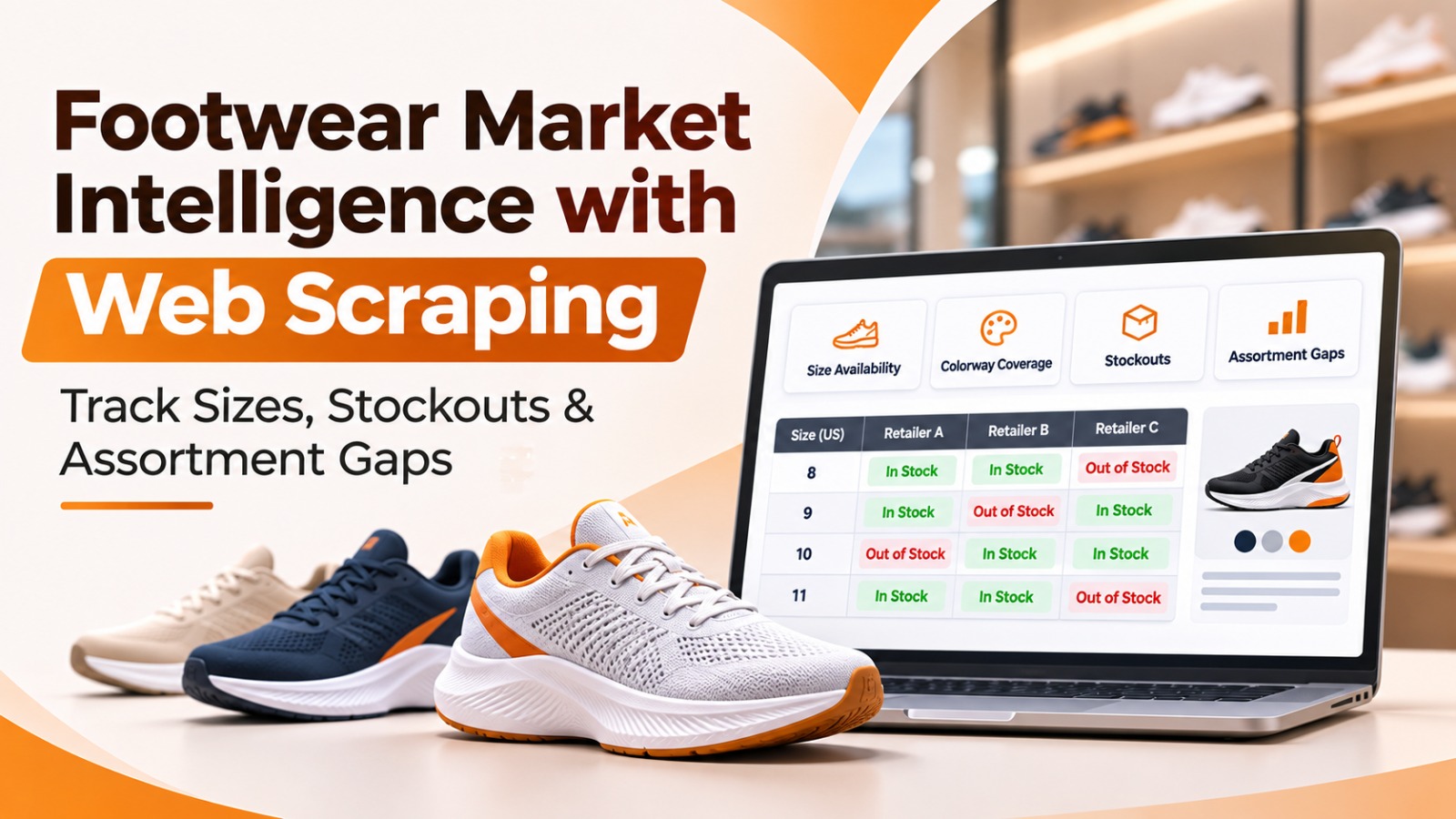
Build a size-level stockout worksheetThe sample matrix below represents one hypothetical men’s running shoe in a black colorway, using US sizes. It illustrates the method; it is not a measurement of actual retailer inventory.
US sizeZapposFoot LockerDSW7In stockIn stockIn stock8In stockOut of stockIn stock9Out of stockOut of stockIn stock10In stockIn stockOut of stock11In stockOut of stockIn stock12Out of stockIn stockNot listed13In stockIn stockNot listed
In this example, Zappos has five of seven listed sizes available (71.4%), Foot Locker has four of seven (57.1%), and DSW has four of five (80%). However, DSW covers only five of the seven reference sizes (71.4%). This shows why availability and assortment coverage must be measured separately.
To extend the worksheet, create another matrix for each colorway and date. Keep an observation log with style ID, retailer, colorway, size, width, ZIP code, timestamp and stock status. Use that log to distinguish repeated stockouts from a single unavailable observation.
Key metrics for footwear market analysisMetricCalculationSize availabilityIn-stock sizes / listed sizes × 100Size stockout rateOut-of-stock sizes / listed sizes × 100Size-range coverageListed reference sizes / reference sizes × 100Colorway coverageListed reference colorways / reference colorways × 100Recurring stockout rateOut-of-stock observations / valid listed observations × 100
Exclude unknown observations from availability and stockout denominators, and report their share separately. Define the reference range before comparing retailers. Where a size was never observed as listed, label it an assortment gap rather than a confirmed stockout.
Turn footwear data into merchandising decisionsCategory teams can use size-level tracking to benchmark assortment depth, identify frequently unavailable variants and prioritize further research into underserved sizes. Comparing colorways across retailers can reveal differences in product variety, while combining stock observations with competitor price monitoring ↗ can show how availability changes alongside promotions.
A persistent competitor stockout is a signal worth investigating, not proof of demand. Validate the opportunity using sales, customer searches, returns or other first-party information before making purchasing and replenishment decisions.
ConclusionFootwear market research becomes more useful when it measures what shoppers can actually purchase. A consistent variant-level dataset, reference size range and repeated observations help brands distinguish temporary stockouts from structural assortment gaps and make better-informed category decisions.
Want to compare footwear sizes, colorways, prices and availability across retailers? Request a footwear market data sample from KVETOiQ ↗.