

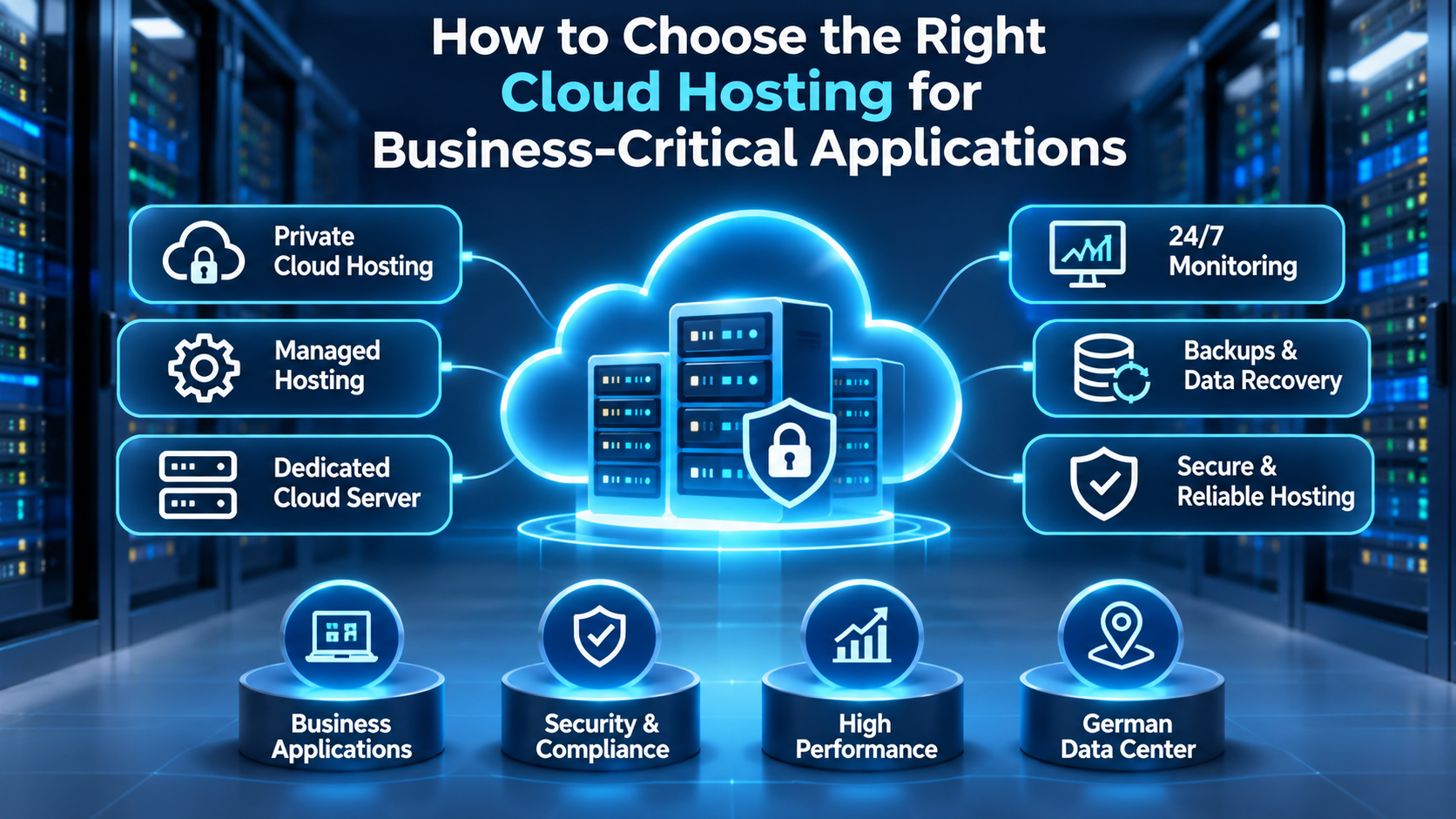
How to Choose the Right Cloud Hosting for Business-Critical Applications

Choosing cloud hosting for a business application is about more than finding a server with enough storage and processing power.
When an application supports daily operations, communication, customer service, documents, or internal workflows, the hosting environment becomes an important part of the business infrastructure.
An outage can interrupt work. Poor performance can frustrate users. Weak backup procedures can create unnecessary risk. And infrastructure that requires constant attention can place additional pressure on an internal IT team.
So how should a business evaluate cloud hosting?
The best approach is to start with the application and then consider performance, security, monitoring, backups, management, and recovery.
What Is Cloud Hosting?Cloud hosting provides computing resources through a networked infrastructure rather than relying on a single traditional server arrangement.
Businesses can use cloud environments to host websites, databases, business applications, email systems ↗, ERP platforms, document management solutions, and other workloads.
However, not every cloud environment is designed in the same way.
Some businesses may need flexible shared resources, while others may require dedicated infrastructure or a private cloud environment.
The right choice depends on the workload and the level of control the organization requires.
When Should a Business Consider Private Cloud Hosting?Private cloud hosting can be useful when an organization needs dedicated infrastructure, specific security controls, or greater control over where its applications and data are hosted.
This can be particularly relevant for business-critical applications where predictable infrastructure and data management are important.
Private cloud does not automatically mean that an environment is secure. Security depends on the architecture, access controls, network protection, monitoring, backup strategy, and operational practices surrounding the infrastructure.
Businesses should therefore evaluate the complete environment instead of choosing a hosting model based on terminology alone.
Managed Hosting vs. Self-Managed InfrastructureOne of the most important decisions is determining who will manage the infrastructure.
With managed hosting, the provider takes responsibility for defined operational tasks such as monitoring, updates, backups, or maintenance.
This can be useful for businesses that want their internal IT teams to focus on applications and business operations.
Self-managed infrastructure provides more direct control. An organization with experienced system administrators may prefer to manage the operating system, applications, configuration, and security settings itself.
ITIS provides both managed SaaS hosting and unmanaged dedicated cloud server options. Its managed model includes backups, updates, and real-time monitoring, while the unmanaged dedicated server model provides full root control.
The important question is not which model is universally better. It is which model matches the company's technical resources and responsibilities.
How Important Is Server Performance?Different applications have different resource requirements.
A small website may work well with modest infrastructure.
An ERP system used by dozens or hundreds of employees can have very different CPU, memory, storage, and database requirements.
A dedicated cloud server can be useful when a business wants resources allocated to a particular workload rather than relying on a general shared environment.
ITIS states that its dedicated cloud infrastructure supports business applications including Odoo, Zimbra, and Alfresco.
Before selecting infrastructure, businesses should estimate current resource usage and expected growth.
Security Should Be Evaluated as a Complete SystemA secure cloud environment requires multiple layers of protection.
Businesses should ask how a provider handles:
Network securityFirewallsAdministrative accessOperating-system updatesPhysical data-center securityBackup protectionMonitoringAccess permissionsITIS describes a hosting architecture that includes triple-firewall protection, dual reverse proxies, regular Linux-based security updates, digital access controls, physical security, and encrypted offsite backups.
These details demonstrate why security should be evaluated as an overall architecture rather than by looking at one feature.
Why Does Continuous Monitoring Matter?A server does not need to be completely offline for a business problem to develop.
Storage can gradually fill up. Resource consumption can increase. A service can become unstable. A network issue may affect only part of an application.
Continuous monitoring helps identify these conditions earlier.
ITIS states that its data-center control room operates around the clock and monitors dedicated cloud server and SaaS hosting environments.
For business-critical applications, monitoring can therefore be an important part of the hosting service rather than an optional extra.
What Should a Cloud Backup Strategy Include?Backups are essential, but businesses should look beyond the simple question of whether backups exist.
A useful backup strategy should define:
Backup frequencyStorage locationRetention periodEncryptionAccess controlsRestoration proceduresITIS states that its infrastructure uses incremental daily backups and full weekly backups, with offsite storage protected by password and encryption.
The appropriate schedule depends on the application.
A business should first determine how much data it could afford to lose and how quickly the application needs to be restored.
Disaster Recovery Is Different From BackupA backup protects a copy of information.
Disaster recovery focuses on restoring operations.
For example, recovering an application after a major infrastructure failure may require more than restoring a database. The organization may also need application configuration, operating-system components, networking, authentication, and other dependencies.
A good recovery plan should identify these dependencies before an incident occurs.
ITIS states that customer data is mirrored in physically separate locations within Germany to support restoration and business continuity.
Businesses should still assess recovery arrangements according to their own recovery-time and recovery-point requirements.
Where Is the Data Hosted?Data location can matter for privacy, contractual, regulatory, and operational reasons.
Some businesses may have requirements concerning where customer or company data is stored.
ITIS states that its private cloud infrastructure is located in Bavaria, Germany, and that customer data remains in Germany.
When comparing providers, businesses should verify current contractual terms, data-processing arrangements, and compliance documentation rather than relying only on marketing descriptions.
Is SaaS Hosting Suitable for Business Applications?SaaS hosting can reduce the infrastructure responsibilities handled internally.
Instead of maintaining the complete hosting environment themselves, businesses can use a managed environment where the provider handles defined infrastructure tasks.
This can be useful for organizations that need business applications but do not want their internal teams spending significant time on server maintenance.
ITIS provides managed SaaS hosting and lists applications such as Odoo, Zimbra, and Alfresco among its supported business application environments.
The suitability of SaaS hosting depends on the application's requirements and the responsibilities included in the hosting agreement.
A Simple Cloud Hosting ChecklistBefore choosing a provider, businesses should ask:
Does the infrastructure match the application's workload?
Are dedicated resources available if required?
Who handles maintenance and updates?
How is the infrastructure monitored?
How frequently are backups performed?
Where are backup copies stored?
How quickly can the application be restored?
Where is business data physically hosted?
Does the provider support the application being deployed?
Can the environment accommodate future growth?
These questions provide a more useful basis for comparison than simply choosing the lowest monthly price.
Final ThoughtsThe right ↗business cloud hosting ↗ ↗environment should support the application without creating unnecessary operational complexity.
Some businesses may need private cloud infrastructure. Others may benefit from managed hosting or a dedicated cloud server. The correct choice depends on workload, security requirements, internal expertise, data-location needs, and recovery objectives.
For organizations evaluating private cloud, managed SaaS hosting, or dedicated infrastructure, ITIS provides several hosting models for business applications in Germany.
Ultimately, good cloud infrastructure should do more than keep an application online. It should provide a practical foundation for performance, security, monitoring, backup, and business continuity.