

Ecommerce App Scraping: What Retail Apps Show That Desktop Stores Miss
Ecommerce App Scraping: What Retail Apps Show That Desktop Stores Miss
A retailer’s website may show a product in stock at a competitive price, but that does not necessarily tell the whole story. A customer opening the same retailer’s mobile app might encounter a different promotion, a store-specific pickup option or a faster delivery estimate. These differences can change how customers evaluate an offer and where they decide to buy.
For pricing teams, marketplace sellers and retail analysts, monitoring desktop websites alone can leave important gaps in competitive intelligence. Combining app observations with ecommerce data scraping services ↗ helps businesses assess whether their existing datasets reflect the shopping experiences they actually want to measure.
What is ecommerce app scraping?Ecommerce app scraping is the structured collection of eligible retail data displayed through mobile shopping applications. Depending on source permissions and availability, the data may include product identifiers, prices, promotional conditions, stock status, search positions and fulfilment options. Unlike a general mobile app extraction project, the emphasis is on connecting these observations to retail decisions.
The goal is not to assume that mobile apps always contain unique information. It is to determine which fields are shared across channels, which differ and which cannot be observed reliably. Where permitted, mobile app data scraping ↗ can complement website collection when the web experience does not provide equivalent coverage.
Why retail apps and websites can show different dataRetailers design shopping experiences around customer context, including selected stores, delivery addresses, account eligibility and device-specific features. The Target app ↗, for example, describes shopping features involving savings, pickup and delivery. The Walmart mobile app ↗ describes tools for checking prices and availability. These are useful starting points for a coverage assessment, not proof that either retailer consistently offers lower prices in its app.
Differences can also arise from collection timing, seller selection or a temporary inventory change. A valid comparison must separate genuine channel differences from these other variables.
Six retail data signals worth comparing1. App-exclusive prices and discountsAn app may surface a coupon or promotion that is not visible on the desktop product page. Capture the listed price, discount conditions, eligibility and expiry separately. A coupon available to selected members should not be treated as an unconditional price reduction. This distinction makes promotional comparisons more useful to pricing teams.
2. Location-specific inventoryA product can be available for shipping but unavailable at a nearby store. Record the selected store, ZIP code and fulfilment type rather than collapsing every availability signal into a single in-stock flag. For retailers with local competitors, these details can reveal assortment gaps that national catalog monitoring would miss.
3. Delivery promises and pickup optionsA shopper may see different delivery windows depending on location, time and service eligibility. Target’s same-day delivery guidance ↗ illustrates why fulfilment context matters when comparing retail offers. Capture the displayed delivery estimate and applicable fees, not just the fastest option. A promise is an observation, not proof of actual delivery performance.
4. Product assortment and variantsMobile and desktop interfaces may present different product selections, bundles or variant visibility. Compare matched product identifiers and pack sizes before declaring a channel-exclusive assortment. A missing listing may simply reflect a search filter, a different seller or a collection failure.
5. Search rankings and sponsored visibilityProduct placement influences discovery. Compare the same search phrase across channels while recording organic and sponsored positions separately. Keep the location and sorting settings consistent. Repeated observations are more informative than a single ranking snapshot because results can change throughout the day.
6. Loyalty offers and eligibilityMembership benefits can affect the effective cost of a basket. Record publicly visible eligibility conditions and distinguish general offers from account-specific incentives. Avoid collecting private customer information. If an offer cannot be evaluated without an authorized account, mark it as unverified rather than guessing its value.
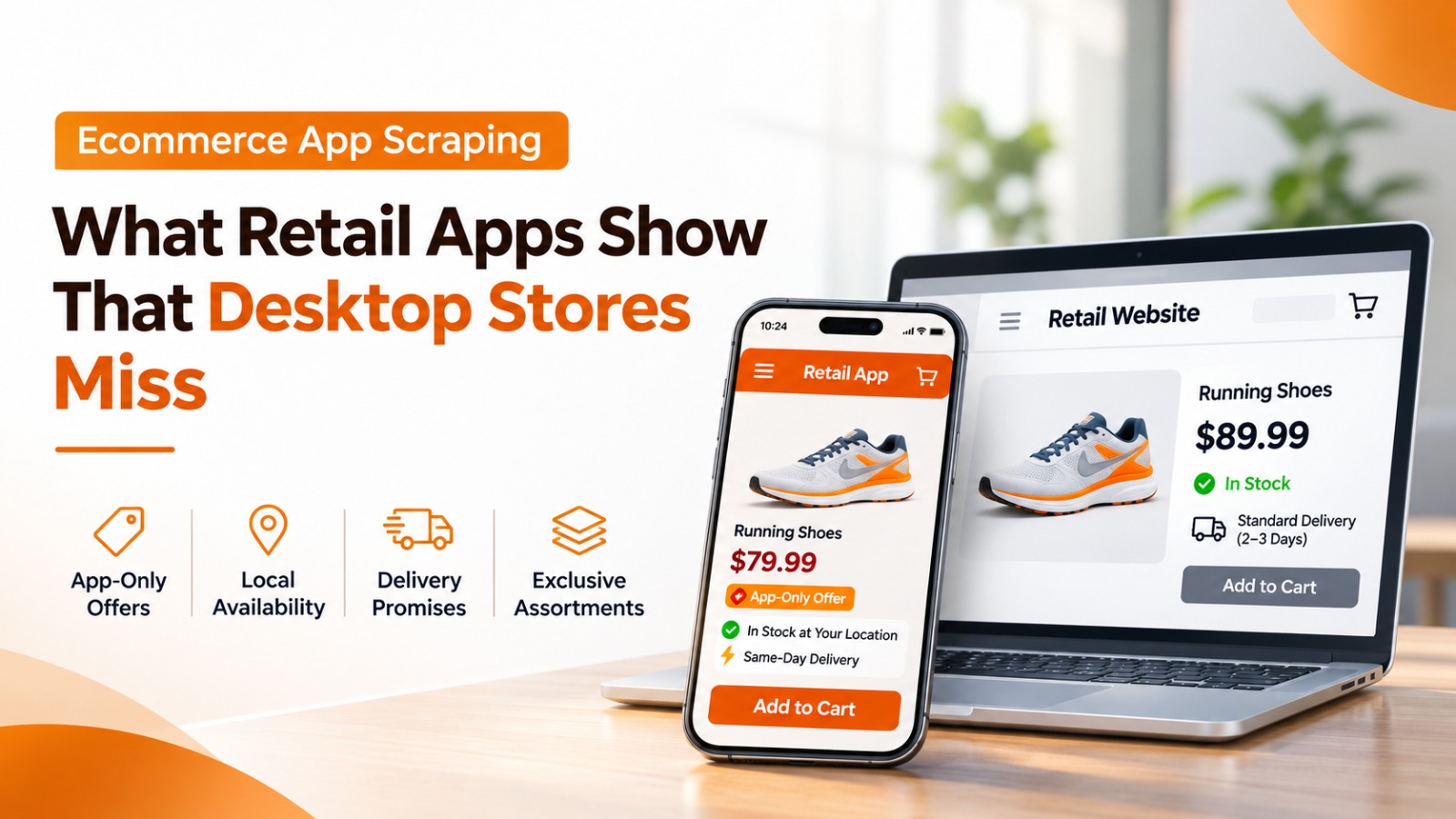
App versus desktop: an illustrative comparisonThe following hypothetical example shows how a matched product observation could be recorded. It does not represent measured prices or offers from a real retailer.
Data fieldMobile appDesktop websiteListed price$99.99$99.99Eligible promotion$10 app couponNot displayedEffective item price$89.99 if eligible$99.99Store pickupAvailableNot displayedDelivery estimateSame day2–3 daysThe example highlights two important distinctions: an offer may be conditional, and a field that is not displayed is not necessarily unavailable. The dataset should preserve both distinctions instead of automatically interpreting missing information as a negative result.
How to compare app and website data accuratelyStart with a limited pilot covering a representative selection of products, retailers and ZIP codes. Choose products with stable identifiers so that matching errors do not distort the results. Define which business decisions the dataset should support before expanding collection.
Match the shopping context. Use the same SKU or GTIN, variant, seller, store, ZIP code, currency, fulfilment method and equivalent account eligibility.Synchronize observations. Capture both channels within a short, defined time window and store timestamps with time zones. Repeat the comparison across several periods.Normalize the fields. Separate base price, discounts, fees, availability, delivery windows and promotional requirements. Use explicit missing-data labels.Validate discrepancies. Review a sample of mismatched records manually. Classify differences as confirmed channel gaps, context differences, temporary changes or unresolved observations.Measure the coverage gap. Divide matched observations with a confirmed channel difference by all valid matched observations. Report the result by data field and retailer, alongside the rate of missing records.This process helps a team decide whether adding mobile data is worth the cost. If both channels consistently expose the same fields, website monitoring may be sufficient. If app observations repeatedly reveal meaningful differences, broader coverage may be justified.
How ecommerce businesses use mobile app dataPricing analysts can combine app and web observations to evaluate promotional positioning and improve competitor price monitoring ↗. Merchandising teams can identify local assortment differences, while marketplace sellers can assess how product visibility changes between interfaces.
For grocery and on-demand retail, delivery windows and local stock can be especially important. Combining quick commerce data scraping ↗ with conventional retail observations can support more detailed analysis of service coverage and fulfilment options. The most valuable dataset is not necessarily the largest one; it is the one that answers the business question with reliable, comparable records.
Challenges and responsible collection practicesApp interfaces change, fields may be personalized, and source permissions can limit what is collectable. Review applicable terms, access rights and legal requirements before collection. Use authorized interfaces or licensed sources where appropriate, avoid bypassing access restrictions, and limit collection to necessary retail information.
The FTC’s guide to protecting personal information ↗ provides useful principles for minimizing and safeguarding personal data. Retail intelligence projects should generally avoid customer identities, payment details and private account information. Maintain source provenance, validation rules and a documented refresh schedule to keep observations interpretable over time.
Build a more complete retail intelligence datasetEcommerce app scraping is most valuable when it fills a demonstrated gap in website-based monitoring. Start with matched observations, validate the differences and expand only when the additional data supports a measurable business need. A combined dataset can help retail teams evaluate pricing, assortment, availability and delivery promises with greater context.
Request a sample of ecommerce app data from KVETOiQ to evaluate coverage for your selected retail sources and business requirements.