

Digital Marketing vs Traditional Marketing: Key Differences
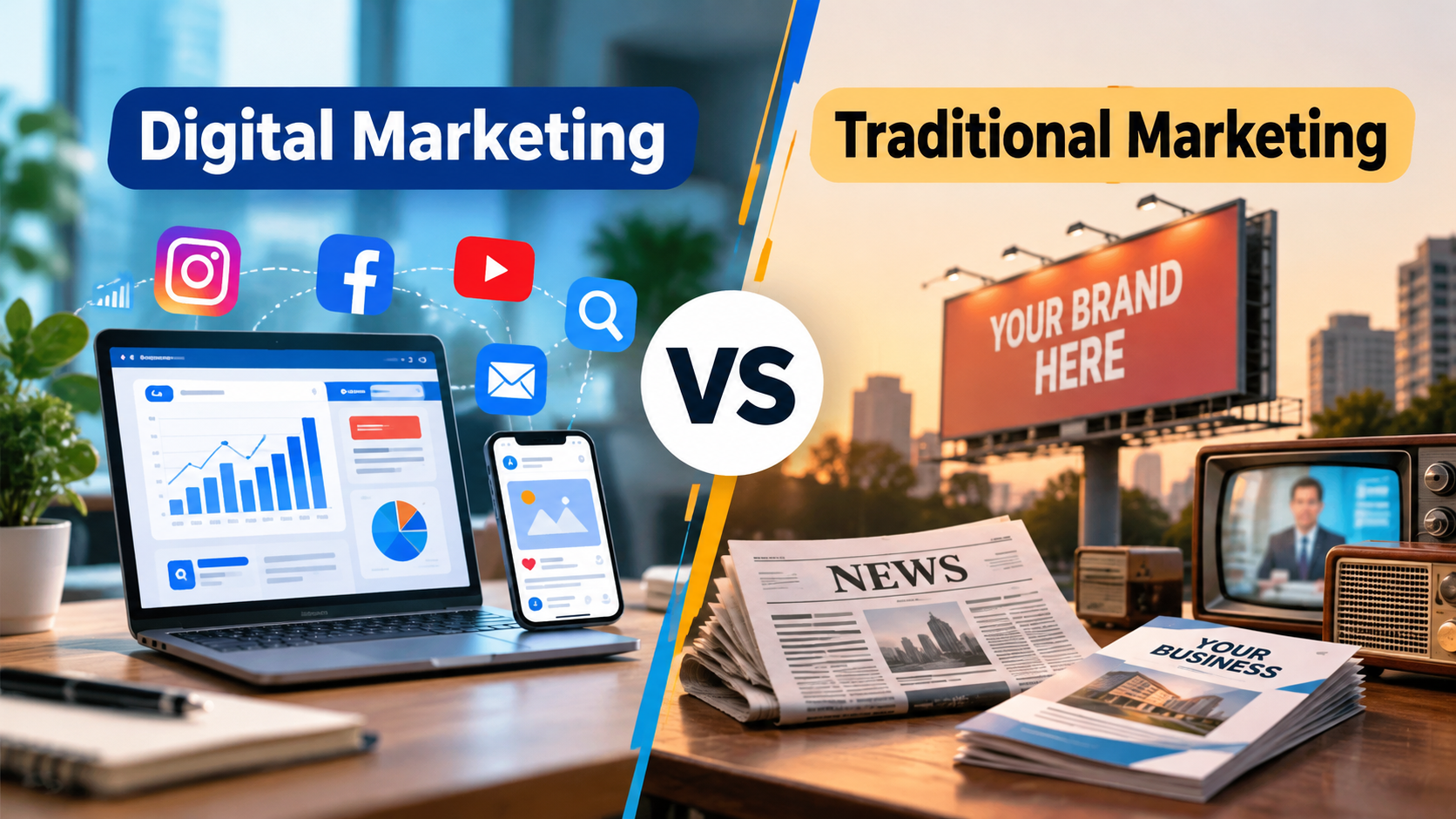
Marketing helps businesses reach customers, promote products, and build brand awareness. Over the years, marketing methods have changed significantly. Traditional marketing uses channels such as newspapers, television, radio, and billboards, while digital marketing focuses on online platforms such as websites, search engines, social media, and email.
Both methods have their own advantages, and businesses often choose between them based on their audience, goals, and budget. Understanding the key differences between digital marketing and traditional marketing can help businesses make better decisions and reach the right customers.
What Is Digital Marketing?Digital marketing refers to promoting products or services through online channels. Businesses use websites, search engines, social media platforms, email campaigns, and paid advertisements to connect with potential customers.
For example, a company can publish content on Instagram, run Google Ads, or improve its website ranking through search engine optimisation (SEO). These activities help businesses attract visitors, generate leads, and increase sales.
One of the biggest advantages of digital marketing is its ability to reach a specific audience. Businesses can target people based on their location, interests, age group, and online behaviour. They can also monitor campaign performance and make changes when needed.
What Is Traditional Marketing?Traditional marketing includes promotional methods that do not primarily depend on digital platforms. Common examples include newspaper advertisements, television commercials, radio promotions, brochures, posters, and outdoor billboards.
These methods are useful for reaching people who consume information through offline channels. For instance, a local business may distribute pamphlets in nearby neighbourhoods or advertise on a billboard to attract people passing through a busy area.
Traditional marketing can help build brand recognition, especially when advertisements appear in familiar and widely used media. However, measuring the exact number of people who become customers after seeing an advertisement can sometimes be difficult.
1. Reach and Target AudienceDigital marketing allows businesses to reach local, national, and international audiences through online platforms. With targeted advertising, companies can focus on people who are more likely to be interested in their products or services.
Traditional marketing often depends on the circulation area of a newspaper, the audience of a television channel, or the location of a billboard. Although these methods can reach many people, targeting a very specific audience may be more challenging.
For example, an online clothing store can display advertisements to users interested in fashion, while a local newspaper advertisement may reach a wider audience with different interests.
2. Cost and BudgetBudget is an important consideration when selecting a marketing method. Digital marketing offers flexible spending options. Small businesses can start with a limited advertising budget and increase their spending based on campaign performance.
Traditional marketing can involve higher upfront costs, particularly for television commercials, large billboards, and advertisements in widely circulated publications. Printing and distribution expenses may also increase the overall cost.
However, the best option depends on the campaign. A well-placed local newspaper advertisement may be valuable for a neighbourhood business, while a carefully targeted online campaign may be more suitable for reaching customers across different locations.
3. Measuring ResultsAnother important difference is how businesses measure marketing performance.
Digital marketing provides measurable data through website analytics, advertising dashboards, and social media insights. Businesses can track website visits, clicks, impressions, enquiries, conversions, and advertising costs.
This information helps marketers understand which campaigns are performing well and where improvements are needed.
Traditional marketing results can be harder to measure directly. Businesses may use customer surveys, promotional codes, enquiry forms, or sales comparisons to estimate the impact of their campaigns.
Digital channels generally offer more detailed and immediate performance data, making it easier to adjust campaigns while they are running.
4. Communication and Customer EngagementDigital marketing supports two-way communication between businesses and customers. People can comment on social media posts, send messages, submit website enquiries, and share their experiences online.
Businesses can respond to questions, address concerns, and build relationships with their audiences. Regular communication can improve customer trust and encourage repeat purchases.
Traditional marketing is usually more one-directional. A television commercial or printed advertisement delivers a message, but customers cannot always respond directly through the same channel.
Although traditional methods can create strong brand awareness, digital platforms provide more opportunities for ongoing customer engagement.
5. Speed and FlexibilityDigital marketing campaigns can be launched, updated, or paused relatively quickly. Businesses can change advertisement text, update website content, adjust targeting, and test different creative ideas without reprinting materials.
Traditional marketing usually requires more preparation. Designing, printing, booking advertising space, and distributing promotional materials can take additional time.
For businesses that frequently update offers or introduce new products, digital marketing can provide greater flexibility. Traditional marketing may still be useful for planned campaigns, local events, and long-term brand visibility.
6. Which Marketing Method Should Businesses Choose?There is no single marketing method that works best for every business. The right choice depends on the target audience, available budget, business objectives, and type of product or service.
Digital marketing may be suitable for businesses that want measurable results, online visibility, targeted advertising, and direct customer engagement. Traditional marketing can be useful for reaching local communities, promoting physical stores, and building recognition through established media channels.
Businesses can also combine both approaches. For example, a company might distribute printed brochures while using social media advertisements to promote the same offer. This helps maintain a consistent message across online and offline channels.
People interested in developing practical marketing skills can explore a Digital Marketing Learning Programme ↗ to understand online promotion, SEO, social media management, and advertising techniques.
Learning how different marketing channels work can help businesses choose suitable strategies and use their budgets more effectively.
ConclusionDigital marketing and traditional marketing both play important roles in business promotion. Traditional marketing can help businesses connect with local audiences and build brand recognition through offline media. Digital marketing offers more precise targeting, measurable results, flexible budgets, and opportunities for direct customer engagement.
The best approach depends on the needs and goals of each business. By understanding the strengths of both methods, companies can create effective marketing strategies that reach the right people and support long-term growth.
Businesses looking to improve their online presence can also explore Practical Online Marketing Strategies for Businesses ↗ — to understand how digital channels can support brand awareness, customer engagement, and business development.